Can Essential Oils be used Undiluted on Your Skin?

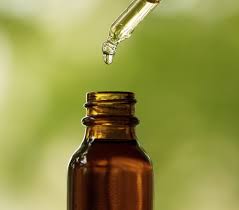
A drop of oil can be essential

A drop of oil can be essential

This question is one of the most commonly asked questions in regards to essential oils and essential oil safety.

I studied in Australia and although I don’t know exactly what other education institutions teach, I’m positive there is a general feeling about this subject.

Short Answer: NO

Do not use essential oils directly on your skin as a general rule.

Why?:

Essential oils are concentrated volatile substances extracted from plants. A couple of important actions in some essential oils are classed as:

Photosensitisation:

If you apply one of these oils  to your skin and go outside, the oil can cause a skin reaction when the suns hits you. It can be really bad, or mild, or you may not get a reaction at all. Oils to watch out for are bergamot and all the citrus oils.

Sensitising:

Many oils can be classed as sensitising, meaning if you use to much, or in a strong dilution it may cause a skin reaction. Oils to watch out for are black pepper, cinnamon, clove, wintergreen, maybe oregano and thyme, and other oils which you wouldn’t be able to buy retail.

Irritation:

According to Essential Therapeutics “irritation” may occur with many different oils in very strong dilutions. However, most essential oils contain different molecules that could potentially cause irritations on the skin, but are not classified as toxic. It really depends on each person and how sensitive you are generally.

The most important thing is not to drink essential oils – this will cause poisoning and potentially harmful long term effects.

Use your common sense and dilute essential oils in the ratios listed in my articles “Ratios for Blending Essential Oils – A Reminder of the Basics” and  “Aromatherapy – It’s Easy as 1 2 3”.

skin reaction to Peru Balsam pic via www.cdc.gov

skin reaction to Peru Balsam pic via http://www.cdc.gov

If you are a very sensitive person then always patch test before using essential oils all over your skin – even if it is in the correct dilution.

I’m not going to say I don’t use essential oils directly on my skin, but I’m not going to say I do. I have 20 years of experience using essential oils with clients and various scenting projects so I feel confident about what I can do on my skin.

Anoint yourself with pure essential oils

Anoint yourself with pure essential oils diluted with a carrier oil

What about anointing with essential oils?

Once again the general rule is not to use essential oils directly on your skin. I recommend diluting with a carrier oil and then anointing.

What about perfume straight from the bottle?

Same as above. if you want a stronger effect, try putting a couple of drops of oil on a makeup pad in your bra or even your handbag.

PATCH TEST FIRST – especially if you are a person who is very sensitive! Just because essential oils are natural does not mean they are always safe.

Don’t use essential oils in strong dilutions, or neat on kids either. if a reaction does occur the only way to get the oils off the skin is with a carrier oil like olive or almond. Smooth it all over the area, wipe off and seek medical advice if necessary. See my article ‘“Aunty, something is biting my legs” – 10 things NOT to do when using Essential Oils” for more info on the general rules of using essential oils.

You are the expert on you

You are the expert on you

You are the expert on you, so use common sense, the information that is available to you and patch test first.

Enjoy the beautiful scents of nature and allow miracles through scent!

Temperance – A Tarot Card Reading with Essential Oils

Temperance - XIV from the Rider-Waite deck

Temperance – XIV from the Rider-Waite deck

My tarot card and essential oil series continues with the lovely card called Temperance.  This card is a bit like the Hierophant card for me – gentle, mild and sometimes it just doesn’t jump out at me with gusto. Depending on what other cards are in the reading, I find it hard to translate.

A beautiful Angel appears before us in a calm scene in nature. This card has a feeling of peacefulness and happiness. In the tarot the water represents emotions and also the subconscious mind. In this card the water is supposed to be flowing upward – from the bottom cup to the top cup. The overall meaning of the water symbols in this card, is balance between the subconscious and the conscious mind. It also represents the balance we need to find between humanity and spirituality. The angels toe in the water also reflects the interconnectedness between humanity and the divine.

It's all about balance - pic via www.homelifesimplified.com.au

It’s all about balance – pic via http://www.homelifesimplified.com.au

You may need to consciously work on balance after a big change in your life, or simply be more mindful of taking care of yourself as much as you do with others. This card could be asking you integrate your spiritual side with your human side to become whole and to find a deep richness in your life.

This is not a time to rush and achieve but to be calm and stress less. Leave all your anxiety and tension behind you as this is the first day of the rest of your life – a life of peace and serenity.

Flow with nature and reap the benefits - pic via www.southernwilderness.com

Flow with nature and reap the benefits – pic via http://www.southernwilderness.com

The flow of the water is asking you to become harmonious with nature, and with yourself. It’s a message to acknowledge how far you’ve come and instills an energy of beauty to help you carry on.

There are many essential oils that can help inspire peace, beauty and wholeness:

1. Open The Bottle and Take a Huge Whiff

Rose – nurture and love yourself

Fennel – be gentle with yourself too

Orange – inspire sweetness and innocence

Rosewood – enhance the flow of love in your heart

Frankincense – breathe deeply and relax

Anoint yourself with pure essential oils

Anoint yourself with pure essential oils

2. Pure Pulse Point Perfume

In a little dish mix these oils and anoint your pulse points or chakras – 3 drops of essential oils and dilute with a few drops of carrier oil – always patch test first!

“Peace”

Allow a sense of peace to fall all around you –

Patchouli        1 drop

Mandarin        1 drop

Frankincense  1 drop

—————————————————————————————————————————————

“Gratitude Gives”

By being grateful you will open up to more beauty and gentility –

Geranium                       1 drop

Australian Sandalwood   1 drop

Petitgrain                         1 drop

—————————————————————————————————————————————

“Bubbling Brook”

Flow like a little stream –

Cardamom      1 drop

Lime                1 drop

May Chang      1 drop

————————————————————————————————————————————–

Happy blending and remember to use your intention when you are creating your formulas. See my article about intention.

copyright suzannerbanks 2013


Perfumery and Aromatherapy – How Do They Relate?

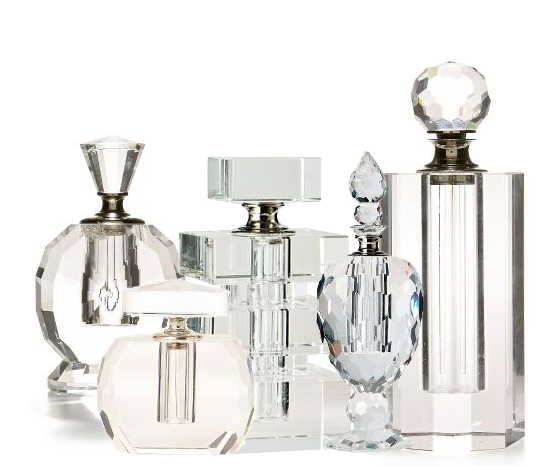
Gorgeous perfume bottles

Gorgeous perfume bottles

Once, a long, long time ago, in a land far, far away these two things were the same. That is, the raw ingredients used for scenting were all natural and were the same things used for healing and well-being. Mother earth provided plants, herbs and flowers to be used by really smart people to create medicines, scents and incense for rituals.

Tapputi-Belatekallim, according to Wikipedia –

“is considered to be the world’s first chemist, a perfume-maker mentioned in a cuneiform tablet from the second millennium BC in Babylonian Mesopotamia.  She used flowers, oil, and calamus along with cyperus, myrrh, and balsam. She added water then distilled and filtered several times. This is also the oldest referenced still.”

This image appears in relation to Taputi - you can see references to a still

This image appears in relation to Taputi – you can see references to a still

Awesome! The oldest reference to pharmacy is credited to a woman. Of course! Recently ancient perfumes have been discovered in Cyprus that have been carbon dated back 4000 years. In these samples scientists found botanicals such as herbs and spices, bergamot, almond and conifer resins. That’s interesting, and for further reading on these resins see my article “Amber – A Complicated Story”.

The old almond - it's still around so it must be good

The old almond – it’s still around so it must be good

So anyway you get the drift. Perfume and medicine originally came from natural sources.

Now jump to 2013 where large pharmaceutical companies run the world. Companies like Monsanto and others create toxic chemicals daily that find their way into our food sources, water and the air we breathe. We have lost touch with the planet and as technology increases faster then the evolution of our souls, we have stuffed up the balance of our little place in the giant cosmos.

Modern perfumery began around the beginning of the 19th century when technology allowed chemists to synthesize aromatic compounds. The rest is history. Click on this link to discover (as an example) the toxicity of Calvin Klein Eternity for Women. This website,  Environmental Workers Group/Skin Deep  is a great database you can use to check out the ingredients of lots of skincare and fragrance items. To be fair essential oils also appear in this database but are mostly listed as safe.

absolutely stunning lavender fields via reddit.com

absolutely stunning lavender fields via reddit.com

Perfumes may also contains parts of essential oils that have been synthesized, like limonene, and many other constituents of oils. But with essential oils, we are using the whole oil, not fractions of it. Granted essential oils are a specific part of the plant that has been distilled rather than the whole plant, but we are on the right track when we are asking nature to support our growth. We in turn must support the planet and live in harmony with the earth.

Essential oils have an energetic resonance. They contain fundamental patterns of nature.

Perfume is created in a lab. It does not contain any part of nature.

64 tetrahedron grid - a building block of the universe

64 tetrahedron grid – a building block of the universe

Essential oils have information embedded within the molecules. We can use this information for healing.

Perfume is fragrance, nothing more.

The choice is yours. Always.

Perhaps you can ask yourself how you can you can support the movement back to nature. Thank you.

copyright suzannerbanks 2013

Nutmeg – A Spice Oil of Mysticism and Intrigue!

Nutmeg - Myristica fragrans

Nutmeg – Myristica fragrans

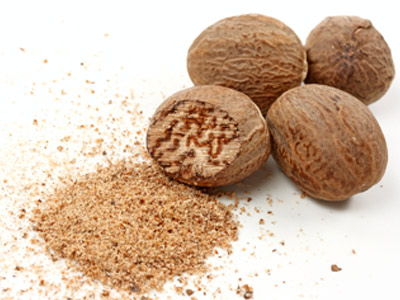
Just look at this gorgeous pod of deliciousness!

The red, almost brain-like cover is what mace is made from. The nutmeg we know and love, and use in cooking is hidden underneath. Isn’t nature wonderful? The colours are divine and the nutmeg seed is protected by layers of cellular material. This seed is part of the whole pod which is actually the fruit of this evergreen tree.

The nutmeg tree

The nutmeg tree

Like many spices and spice oils, nutmeg has a rich history spanning, in the very least hundreds of years, and probably even more. Originating from the Banda Islands, north of Timor and west of Papua New Guinea, the trade of this wonderful spice is traced as far back as the middle ages in Europe. You can imagine how long before this the islanders would have used this amazing plant.

In the 1600’s the Dutch East India Company ruled the spice trade and the beautiful islands. They staged a nasty takeover of the islands to absolutely rule and control the supply of nutmeg to the world. When the Brits took over they transplanted many of these nutmeg trees to other islands under British rule and because of this Grenada actually produces 20% of the world’s nutmeg supply. They even have an illustration of the nutmeg on their flag.

The flag of Grenada

The flag of Grenada

Our modern history is quite brutal really. Thank goodness we are now in a time of rapid evolution – the best time to employ essential oils to get us all to the next level of peace and harmony.

The essential oil of nutmeg is steam distilled from the seed and it is high in a-pinene (alpha pinene, b-pinene (beta pinene) and sabinine (also in black pepper oil); with many other constituents including camphene. We know that camphene (and other types of camphor molecules) are warming and stimulating constituents – and so is the oil of nutmeg.

The traditional uses of nutmeg include:

* to ease the symptoms of colds and flu

* as a tonic to warm the body

* as a treatment for all things digestive – to stimulate appetite, to treat nausea and vomiting and to generally stimulate the digestive fire

* as an anti-inflammatory agent especially in the treatment of arthritis and swelling of the joints

* to warm aching muscles and joints

The nutmeg spice is known as an hallucinogen due to a chemical constituent called elemecin, which Wikipedia claims is similar to the properties of mescaline. According to Salvatore Battaglia (an aromatherapist and author of a great book called “The Complete Guide to Aromatherapy”), this is lost in the distillation process and is not present in the oil.

Isn’t it interesting that the red mace covering of the seed looks like a brain – and that the seed can effect the brain, inspiring whacky mind visions!

nutmeg

nutmeg

I use this oil as a connection to spirit – as an awakening oil of the mind and the higher chakras. I find nutmeg oil to be expansive on all levels of our existence – the physical, the emotional, the mental and the spiritual. And just the fact that it’s called “myristica”, I always think of this oil as an agent of attaining our mystical existence, and accessing our mystical guides. I use this oil when I need to connect to universal intelligence.

Try these recipes:

1. Pure Pulse Point Perfume

In a little dish mix these oils and anoint your pulse points or chakras – 3 drops of essential oils and dilute with a few drops of carrier oil – always patch test first!

“Sweet Release”

Allow divine guidance to enter your world

Nutmeg        2 drops * patch test first as nutmeg could be sensitising to the skin

Orange         1 drop

————————————————————————————————————————————–

2. Scent Your Space

In a traditional oil burner with a candle or a diffuser add 25 drops of oil

“Intergalactic Love”

Reach out into the universe with love

Nutmeg        10 drops

Rosewood     8 drops

Mandarin       6 drops

————————————————————————————————————————————–

Remember to use your intention when you are blending, it will add to the creation process and also be an exercise in using your intuition.

copyright suzannerbanks 2013

Amber – A Complicated Story

Baltic Amber - from a few different species in the Mediteranean

Baltic Amber – from a few different tree species in the Mediterranean

The other day my client asked me about amber oil. I told her that I’d researched it years ago and that it didn’t seem to be straight forward – and that I’d forgotten everything too, and that I never used it. She had a little sample of resin and it did smell beautiful. So what is her sample, really?

It seems there’s a few stories floating around out there which include –

Ambergris – sperm whale vomit or poo

Liquidambar orientalis – the sap from the tree

Baltic amber or succinite – the hard crystals we know that are used for jewelly

and

Pinus succinefera fossil – fossilised sap

Here’s what I can gather about the truth of Amber oil.

Ambergris

ambergris - I think

ambergris – I think

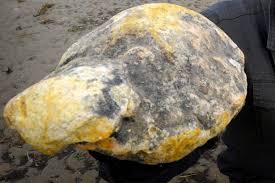
Ah yes the lovely scent of sperm whale poo and vomit. The ambergris seems to be a secretion in the digestive system of the whale to protect it’s gut from spikey cuttlefish. It is excreted with fecal matter, or regurgitated if the amount is too large to pass.The story goes that this intriguing substance was found around the Atlantic Ocean along the shorelines of many countries including Australia and NZ, Japan, South Africa, The Maldives and other areas in the world. Apparently as it aged, the scent changed to a sweet balsamic, earthy odour and was therefore grabbed and distilled by perfumers to use as a fixative in scents. It can still be found today and is worth a lot of money! If you have a perfume with that listed it would be synthetic. All perfume is synthetic anyway, so don’t panic, there’s no vomit in your fragrance.

Liquidambar orientalis

This seems to have more credit in the ‘amber stakes’. The name also has “amber” in it so there’s a bit of a hint (or coincidence). This gorgeous tree is planted all over Sydney and I believe it originates from the Mediterranean region, particularly in Turkey. The trees are referred to generally as “sweet gum” and these forests in Turkey (according to wikipedia) are under threat due to dam building and clearing for agriculture. This oil is also produced in India, and the tree is also native to India.

In English, this oil is known under several names, shortly as Storax to include all sweetgum oils, or as Styrax Levant, Asiatic Storax, Balsam Storax, Liquid Storax, Oriental Sweetgum Oil, or Turkish Sweetgum Oil. …. it is used externally in traditional medicine for abrasions, anxiety, bronchitis, catarrh, coughs, cuts, ringworm, scabies, stress-related conditions and wounds. It is a different product than the benzoin resin produced from tropical trees in the genus Styrax.

Wikipedia

I have never used this oil but now I’m a bit desperate for it. It sounds bloody gorgeous. We had a beautiful liquid amber tree in our backyard when I was growing up. I did a school project on it – if I’d only know it contained a medicinal, scented secret!

As with Frankincense and Myrrh, the tree is tapped and the sap collected. To produce the oil, the resin then undergoes steam distillation.

Baltic Amber

Baltic Amber with a fossilised insect

Baltic Amber with a fossilised insect

Baltic amber refers to fossilised tree resin from a variety of conifers living around the Scandinavian countires and the Baltic region. The Pinus succinefera is one of these trees and this stone is sometimes referred to as succinite (and also because it contains succinic acid).The Baltic region contains most of the world’s supply of amber which could be between 40 to 60 million years old! Oh dear should we really be digging this up?

So this leads us to the claims that this stone can produce a resin, then an oil.

Pinus succinefera – fossil

Pinus succinefera - the fossil - also possibly Baltic amber

Pinus succinefera – the fossil – also possibly Baltic amber

This fossil relates to the Baltic Amber above. But can the stone produce this oil? How is it extracted? Dry distillation could be used, whereby a solid is heated to produce gasses and materials which are then condensed and collected. This is a fossilized resin so I’m wondering if the claims that the oil is Pinus succinefera – fossil, are false.

There are stories of this stone and resin/oil being used by the Romans and Greeks to use medicinally and in rituals. Did they have dry distillation techniques or were they collecting sap and distilling it?

It’s all very interesting and if anyone has anything to add or can clarify any of these claims I’d be grateful. Just leave a comment.

My money is on Liquidamber orientalis but none of my trusted suppliers sell this. Hmmmmm.


copyright suzannerbanks 2013

Ginger – an Oil of Warmth and Movement

ginger - a fantastic food and oil

ginger – a fantastic food and oil

I used ginger oil in 2 treatments last week, and loved every minute of them.

Treatment 1

Rosemary, Ginger and Geranium

My intention for this blend was to create warmth in the muscles, and release muscle tension so there was more room for fluidity and movement.

The blend was stunning and the geranium was the little sweet treat the ginger and rosemary needed to be more appealing to the nose, and to add a little happiness and joy.

Treatment 2

Ginger, Rose Geranium and Orange

This blend was created to treat stomach upset and IBS. It was important to make ginger the star here, so I just added some rose geranium (because my client likes the scent, it’s a delightful flower oil that inspires joy, and I must have had it on my mind from the previous blend) and some orange for sweetness. Having bad digestion can indicate someone may not be enjoying and “digesting” life.

It must have been the ginger-geranium week and these two oils work really well together. So do ginger and orange!

Geranium in my street

Geranium in my street

So what is Ginger good for?

The ginger root is used for

– treating upset stomach and sea sickness

– making a hot drink with lemon and honey to reduce the symptoms of a cold

– warming the extremities by drinking ginger tea or taking a straight shot of ginger juice

The essential oil can be used for the same things physically, and in a meta-physical sense I use ginger oil to

– negate the colder/harder parts of my mind and thinking

– enhance my ability to communicate in a softer way

– help to focus on dharma and purpose in life

Here are some recipes to try:

Scent Your Space

In a classic oil burner or diffuser add these oils

“Joan of Arc”

To inspire your inner fire and find the purpose of your life;

Ginger               10 drops

Mandarin            8 drops

Peru Balsam      6 drops

—————————————————————————————————————————————

“Qi”

To allow room for movement and change in your body (particularly heart chakra) and mind;

Ginger              10 drops

Rosewood         8 drops

Petitgrain           6 drops

—————————————————————————————————————————————-

Shower Steam

Open a bottle of ginger and pour 10 drops into the bottom of the shower (cover the drain with a cloth or your foot). Breathe in deeply. This will soften your emotions and help you feel compassion for others.

Good for before work, if you have any challenging stuff going on at the office.

—————————————————————————————————————————————-

Pure Pulse Point Perfume

Anoint your beautiful self with a few drops of oil. It’s a secret treatment for YOU, and YOU only.

Mix these oils together and dab on your wrists, heart, anywhere you are called to do so. If you are not sure ask the angels for guidance – they will silently place the answer in your mind.

In a little dish mix these oils and anoint your pulse points or chakras – 3 drops of essential oils and dilute with a few drops of carrier oil – always patch test first!

“Give Me Strength”

Garner a little extra energy for the day ahead;

Ginger            2 drops

Lavender        1 drop

—————————————————————————————————————————————-

“Kindness, Compassion and Baby Animals”

When YOU feel you need to show more compassion to another person;

Ginger                     1 drop

Rose in 3% jojoba   2 drops

—————————————————————————————————————————————-

Make ginger oil your friend and rejoice in the amazing results!

Remember to treat your self first, then everyone will benefit.

copyright suzannerbanks 2013

Rose and Rosehip – A Winning Combination for Youthful Skin

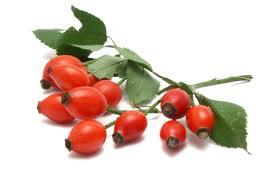
rosehips

rosehips

I declare the best facial moisturiser in the entire world to be essential oil of rose with rosehip oil. Some may disagree but I don’t care because I love it. And here’s why ……

Rosehip Oil

the orange colour of reosehip oil

the orange colour of rosehip oil

Rosehips are the little buds left on a rose bush after the flowers have gone. They are high in Vitamin C and are now being used in supplements for immune strength and as an anti-inflammatory agent in joint formulas too. We have been drinking delightfully pink rosehip tea for years too, which is high in anti-oxidants and can help with colds and flu. It is the fruit of the rose bush and is also used in jams and jellies.

The oil can be extracted by cold pressing the buds or by using CO2 extraction process. This sounds a bit technical but it is actually a good way to extract oils as not much energy is needed, and the products are very near to their natural state.

It is obvious that all these amazing properties are present in the oil which is a dark orange colour, quite viscous with a distinct scent. It is luxurious to say the least and I find it funny when I read the back of the labels of some retail products that say to use “a few drops”. I use way more than that everyday. I use a decent pump’s worth. It is hydrating. soothing, and the Vitamin C really keeps your skin looking and feeling youthful!

Sometimes the scent is what puts some people off but I use it straight and love it. This is where mixing some rose essential oil into it will turn it into a stunning serum.

Rose Essential Oil

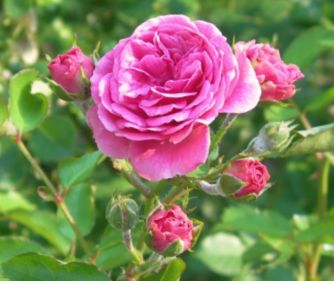
Rosa damascena - the most used rose for oil production

Rosa damascena – the most used rose for oil production

As a skin oil rose is amazing because it treats heat and redness in the skin. It is a complex oil revered through the ages for its use in beauty and femininity. Great for any skin condition from eczema and psoriasis through to scars and sunburn.

It is called the “Queen of Oils” and will make you feel just that. It is an oil of inner strength and wisdom.

Who wouldn’t want to have it everyday? I’d take a drop of rose oil over any perfume or any scented skin cream, any day.

Quantities for mixing (assuming you have rose 3% in jojoba):

5 mls rosehip oil          add           4 drops

10 mls rosehip oil        add           7 drops

15 mls rosehip oil        add          11 drops

20 mls rosehip oil        add          15 drops

25 mls rosehip oil         add          19 drops

30 mls rosehip oil        add          22 drops

(These are my own ratios for any oil in 3% jojoba for the face. It will be a higher concentration for the body. They are also rounded up and down to get a whole drop – unless you can get 1/2 a drop or 3/4’s of a drop, but I cant seem to do that very well!)

Or just pump some rosehip onto your fingers and add a few drops of rose oil. Sometimes we just need to simplify things.

create your own natural skincare

create your own natural skin care

For more notes on rose oil please see my article “Stop and Smell The Roses”


copyright suzannerbanks 2013

Stop and Smell the Roses

Rosa damascena - the most used rose for oil production

Rosa damascena – the most used rose for oil production

Rose is a rose is a rose is a rose.

Gertrude Stein, 1935

Some say Gertrude Stein is referring to the rose like this to express her feeling that things are what they are. According to Wikipedia: “In Stein’s view, the sentence expresses the fact that simply using the name of a thing already invokes the imagery and emotions associated with it,..”

So when you say rose do you invoke the scent, or the colour, or everything? It is the most romanticised flower in history and appears in many poems, prose and plays. It is often associated with love and intimate moments of the heart.

Do you take time to stop and smell the roses? What is life if we don’t connect to its beauty at every turn? The scent of a beautiful rose is a true gift of nature which invites us to convene with the oneness of the universe in the now!

Rosa centifolia - another rose used to make essential oil

Rosa centifolia – another rose used to make essential oil

I never buy a rose that doesn’t have a scent – to me that’s the most important part. Isn’t it a wonderful thing when you enter your house to be greeted by the natural perfume of roses? Essential oil of rose is made by either steam distillation or as an absolute (where the scent is extracted into a fat and then lifted by a solvent). I tend not to buy absolutes as there seems to be a heavy chemical intervention and I’d rather have my oils extracted in the simplest way.

Rose oil is a complex arrangement of hundreds of molecules, some of which have still not been identified. No wonder it is referred to as the “Queen of Oils”.  We know Cleopatra used roses in her beauty regime, and it is claimed she used rose petals in her boudoir to seduce Marc Anthony from the Roman Empire. The Romans used roses too, and the mention of roses appear in Christian, Buddhist and Confucian literature. Roses are seen in Asian motifs dating back to 3000 BC. It seems as though commercial production of rose oils and rose by products can be traced to Persia in the 10th century. The oil was referred to as “attar of roses” or “rose otto”, which is a term still used today.

Rosa gallica - a sub species named "James Mason"

Rosa gallica – a sub species named “James Mason”

So what can we use use rose oil for?

* use rose oil to help with any heat or infection in the body (you would put a few drops into some carrier oil and smooth it on the face and body –  a great treatment for any illness)

* use this rose body oil to help take the sting out of eczema and psoriasis

* a drop on the temple to relieve stress and tension and counteract a headache

* a great oil for attending to grief (use it a single drop on the heart chakra or in a personal mist or room mist)

* a drop added to your facial oil or cream will refine your skin and give you one of the most powerful aromatherapy treatments in the world. You will feel soft, unruffled, connected to the universe and ready to be the Queen of your world

* a few drops of rose oil in an oil burner will create a scented paradise of peace and calm so it’s great for upset children, the elderly and even pets (if you are using 3% in jojoba it’s not really suitable for an oil burner – you will need to buy the pure oil)

* a drop or two in the right place, as a perfume, will do amazing things for your self esteem as rose is the oil of self-love and nurturing

When buying rose oil you will mostly find it comes in a 3 % dilution in jojoba oil and this is simply because it is a premium oil and is very expensive. Even if you buy wholesale, pure rose oil can cost hundreds of dollars. It is precious!

Remember, treat yourself first then everyone will benefit!


copyright suzannerbanks 2013

Fir and Pine – Fresh and Clean

Pine

Pine

PINE

Pine is most associated with this time of year, if you celebrate Christmas. There are many types of Pine but the one most used for the essential oil is Pinus sylvestrus – often referred to as Scots Pine. From what I can gather, yes it is actually found in Scotland and is native to parts of Europe and Asia.

I do love this oil but rarely use it in a body oil blend for a treatment. It can be a bit harsh to use all over the body and is more effective used an inhalation to help with breathing and upper respiratory tract infections. The scent is bushy and fresh and is fantastic used for scenting a space and doing an energetic cleanse. You can have an aromatherapy treatment, clean and disinfect your house, and create a clean slate for new beginnings, all with a few drops of pine oil.

When you are doing a ritual or energetic cleanse of a space, your intention is as important as the oils you use. Always go with your positive intention and emotions rather than trying to clear negativity (even though this may be your goal). So instead of thinking/chanting/saying something like this;

“I’m purging all the toxic energy of my past relationship…”

try saying

“I love living in my beautiful, happy and creative space”.

As you clean, just have this thought in your mind. You can do this with any essential oil but Pine is one that lends itself to clarification. The oil comes from a steam distillation of the twigs, buds and needles and has a spicy green scent, perfect for inviting the energy of nature into your home

FIR

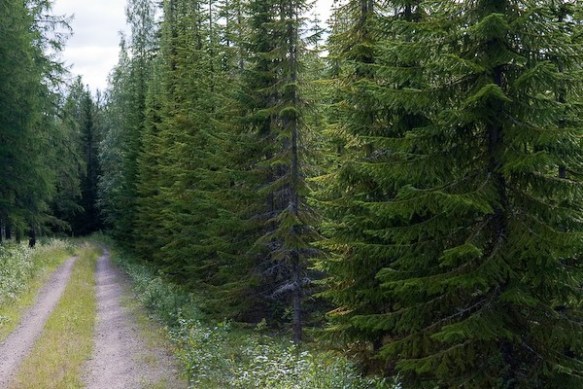
a fir forest in Finland borrowed from cartinafinland.fi

a fir forest in Finland borrowed from cartinafinland.fi

I’ve got a beautiful Siberian Fir essential oil – Abies sibirica. It is a part of the Pinacae family, but firs differ to pines in that their leaves are flat. “Flat, friendly fir” I remember a Park Ranger telling me in Arizona somewhere. Pine needles are cylindrical.

Anyway, the scent of the fir essential oil is much softer than that of pine but I really don’t use this essential oil all over the body either. This family of trees can be slightly sensitising to skin and tends to be more powerful used as a tonic for the emotions and energy. It’s main constituents on a typical breakdown are bornyl acetate, alpha and beta pinene and camphene and the oil can be seen as warming as is often claimed to be a great analgesic to rheumatism.

I would choose fir over pine for the scent. With pine, it can tend to be a bit more medicinal smelling. Fir is warmer and softer and a little bit more special and lovely to use in a perfume. Fir can be used in the same way as pine for cleaning and cleansing so why not give it a go?

Remember to use your intention when employing essential oils for health and well being and treat yourself first, so everyone can benefit.

10 Great Reasons to use Essential Oils

There’s a 10 in there somewhere

1. They are from a natural source and have a distinctive scent

Essential oils come from a natural source and you can detect a deepness in their scent that can never be replicated.

2. Essential Oils can set a Mood

When you use essential oil in your home or space, their chemical structures positively effect your emotions and those who enter you’re scented zone. This doesn’t happen with GLADE or other chemical, synthetic fragrances.

3. Oils can support your life journey

Your spirit will be uplifted when you use essential oils to conjure change in your life. This is not about the emotions, it’s about acknowledging your soul with heavenly scents from nature.

4. Essential oils are great for First Aid

Essential oils are great for first aid. Lavender is #1 and Tea Tree is #2. When in doubt use lavender as it has anti-inflammatory and cell regenerating properties. Tea Tree is more

sneakily borrowed from jigzone.com

sneakily borrowed from jigzone.com

anti-bacterial.


5. Use them in your cleaning/cleansing regime

Add essential oils to your cleaning products to leave your home beautifully, naturally scented while removing bacteria and inviting new beginnings.

6. Use oils for a great sleep

Induce and enhance sleep with chamomile, lavender, lemon balm and even orange. The best way to do this is to vapourise the oils in the bedroom. This is great for calming kids down in the evening.

7. They can nurture your skin

Add a drop or two to your moisturiser to stimulate cell growth and leave a wonderful, natural calm energy.

8. Essential oil will make you the envy of your friends

Everyone will notice when you wear essential oils as a perfume or body oil. They have far reaching effects, they are quite magical and a little goes a long way.

9. Essential oils have a medicinal history

When you use an essential oil you are connecting to the history of the plant through the ages. Most oils and the plants they come from, are the original medicines. Using these plants as medicines, early man was connected to Earth as a life giver.

sneakily borrowed from scientificillustration.tumblr.com

10. Essential oils can help you create

Essential oils will help you tap into your creative force by working through your brain and affecting how you see the world. They use their subtle power to weave your subconscious mind into your everyday life. The results can be amazing!